March 1, 2026
 For those who may be interested in becoming the next Sonoma County Poet Laureate 2026-8, nominations are currently scheduled to open on March 6. The Sebastopol Center for the Arts, which kindly and generously sponsors the poet laureate program, will announce the details.
This month I would like to share my thoughts about the role of the regional poet in our society. We all know there is little, or no, money in poetry. Only a few poets nationally can make a living from their poetry, and usually those poets also teach at a university. I made my living as an environmental engineer, but I’m proud to say I made time for poetry, even though one of my supervisors once told me I should stop writing poetry and focus 24/7 on my day job.
If there is little, or no, money in poetry, then why do we persist? Why, on a recent Friday, did a Courage of Poets gather at the State Capitol to bear witness to those killed by ICE? They gathered to demonstrate that, if poets have anything to say about it, members of our society will not be silenced. Poets are witnesses. Lin Mare deVincent, Valley Poet on the Beat on KSVY, if memory serves me correctly, once told me that radio personality Ronny Joe Grooms called poets “first responders.” Meaning that we are among the first to react, in words, to happenings in society. Poetry documents the times we live in and helps ensure we will never forget.
So, I extend my gratitude to everyone in our community who has ever written a poem primarily as an act of witness, realizing the compensation won’t be financial, but the satisfaction that comes from being part of a community of writers. Thank you.
While I was unable to attend the Courage of Poets event in Sacramento, I would like to announce this somewhat related upcoming event. On Saturday, March 21 from 2 to 330 PM, I will co-lead, along with Librarian Terra Emerson, a workshop on the topic of Documenting Current Events Through Poetry. This is a no-cost workshop, and there is no pre-registration required. Just show up and join a community of like-minded writers interested in writing about current events. The community room at the Sebastopol Library can accommodate a good sized group and we don’t want to turn away anyone interested in this topic. The library is located at 7140 Bodega Avenue in Sebastopol. I hope to see many of you there.
Thank you again for being a part of the Sonoma County writing community.
Dave Seter
Sonoma County Poet Laureate 2024-2026
dssocolaureate@gmail.com
________
February 1, 2026
Greetings Sonoma County poets and poetry enthusiasts.
I’ve been thinking recently about poetry’s oral tradition and have been encouraging us to attend public readings because they make poetry come alive while also helping to build community. Another way in which I’ve personally embraced the oral tradition is that I’ve started memorizing poems again. A number of years ago in a workshop led by Kim Addonizio, the students were tasked with memorizing a poem (by another poet, not a poem of their own) and reciting it during class. For that class I memorized Philip Larkin’s 63 line poem “Church Going.” I’ve also been inspired by the Poetry Out Loud competition sponsored by Poets in the Schools. This year will mark the second year in which I will be one of the judges. Finding inspiration in the will of high school students to memorize and recite poems has given me added interest in doing the same. Recently I have re-learned “Church Going,” along with Thomas Hardy’s “The Darkling Thrush,” and James Wright’s “Two Horses Playing in an Orchard.” And while in the past I’ve been reluctant to commit my own poems to memory, I am now able to recite from memory my poem “Open Range.”
In the final few months of my laureateship I’m making an effort to attend reading series and open mics that are new to me. In the month of January, I attended two such gatherings. The first gathering was the Tuesday night open mic series at Brew Coffee House in Santa Rosa, organized by Steph Chevalier, in which participants perform songs, poetry, prose, and comedy in a revue style event. At the event I read two poems off the page but then thought, next time, I would like to set aside the book and recite poems from memory.
The second gathering was the quarterly Patron Saints of Influence reading and open mic at Shady Oak Barrel House in Santa Rosa, organized by Sarah Broderick and Gaia Patience Veenis. Each of these readings is organized around the theme of a literary influencer (Franz Kafka at the January event). At the event I read two surrealistic or speculative poems: “When the Muse Hollers:” and “Do the Fishes Know It’s Snowing.”
And now, I would like to help publicize an opportunity for poetry submissions centered on Petaluma, my adopted home town for the past twenty years. The organizers of Rivertown Poets (Sande Anfang, Shawna Swetech, and Monica Volker) have issued a call for submissions for the anthology they plan to publish: Ode to Petaluma. Poetry submissions are open to all over 18. The theme is Petaluma: its town, river, architecture, landscape, people, history, etc. You do not need to reside in Petaluma. Up to 2 original and unpublished poems per submission. For more details, please see the Calls for Submissions page of the Sonoma County Literary Update website: https://socolitupdate.com/calls-for-submission/
Speaking of Petaluma, many thanks to the Petaluma Historical Library and Museum for hosting my recent workshop “Dusty Artifact or Window Into the Past? Writing Poems On Petaluma History,” at which an overflow crowd of participants received an insider tour by Executive Director Stacey Atchley and then wrote thought-provoking poems about Petaluma, some of which will hopefully find their way into the Ode to Petaluma anthology. Many thanks also to journalist and playwright David Templeton and the Petaluma Argus Courier for publicizing the event as well as my efforts as poet laureate over the past eighteen months.
And now for a few upcoming events.
Sunday February 1 at 2 PM: The Poetry Out Loud competition in which Sonoma County high school students recite poems, with the winner moving on to the State competition. This event, which is open to the public, takes place at Sonoma State University’s Stevenson Hall.
Thursday February 12 at 6 PM: I will be a featured reader at the Speakeasy reading series curated by Brian Martens. This event includes an open mic. The event is held at the Santa Rosa Arts Center located at 312 South A Street. Details at: https://santarosaartscenter.org/events/
Saturday March 21 from 2 to 3:30 PM: I will be co-leading, with Librarian Terra Emerson, a workshop on the topic of “Documenting Current Events Through Poetry” at the Sebastopol Branch of Sonoma County Library located at 7140 Bodega Avenue. Details at: https://events.sonomalibrary.org/event/copy-hold-potential-poet-laureate-event-94149?language=en
Dave Seter
Sonoma County Poet Laureate 2024-2026
dssocolaureate@gmail.com
________
January 1, 2026
Hello Sonoma County poets and poetry enthusiasts.
I thought I would start off the New Year by celebrating the many reading series being offered throughout Sonoma County. Behind each series is an organizer dedicated to keeping poetry a vital spoken word medium. Although I have not yet had the opportunity to attend a session of every reading series offered throughout Sonoma County, here are a few which I have attended, all of which I can recommend. Many thanks to the organizers of these events, which help us to build community.
Café Frida Reading Series: previously curated by Ed Coletti now curated by Gwynn O’Gara. Occurs several months out of the year Spring through Fall on a Sunday afternoon from 1 to 3 PM at Café Frida in Santa Rosa. Several featured readers are presented at each event. Follow the literary update calendar for specific dates in 2026.
New Rivertown Poets: curated by Sande Anfang, Shawna Swetech, and Monica Volker. Alternates between online events on Zoom and in person events at Aqus Café in Petaluma. Takes place starting at 6 PM on the first Monday of the month. Includes featured readers followed by an open mic.
Speakeasy Poetry and Singer/Songwriter Series: curated by Brian Martens. Takes place most months on the second Thursday from 7 to 9 PM at Santa Rosa Art Center. Includes featured readers/singers followed by an open mic.
Poetry Salon at Barrel Proof Lounge: curated by Timothy Williams. Generally takes place once a month on a Tuesday evening from 5 to 7 PM. On occasion it includes an open mic. Barrel Proof Lounge is located in Santa Rosa. Follow the literary update calendar for specific dates in 2026.
Petaluma Poetry Walk: curated by Kary Hess, previously curated by Bill Vartnaw. A one day event historically held on the third Thursday in September. A free, day-long celebration of live readings bringing together poetry and community. The 2025 event featured 26 poets sharing their work across eight local venues.
Santa Rosa Poetry Slam: curated by Jordan Ranft. Held most months of the year on the third Wednesday from 530 to 730 PM at Brew Coffee and Beerhouse in Santa Rosa. The slam is a competitive reading in which the poets are rated and in which the highest scoring poets proceed to the final round.
And here’s a shout out to an event I have placed on my to-do list: Spoken Word Poetry Night takes place monthly at Sonoma Chocolatiers in Sebastopol. For details follow @africaliculture on Instagram.
These are just a few of the many literary events being offered in Sonoma County, so, as always, stay tuned to the literary update calendar.
I would also like to highlight two events I will be leading or participating in this January.
I have been invited to Mendocino County to read at the Ukiah Library as part of the LOBA Reading Series. My reading takes place on Saturday January 17 at 3 PM at the library located at 105 N Main St. Ukiah. There is an open mic during the second half of the event. Details at: https://www.mendocinocounty.gov/Home/Components/Calendar/Event/48213/
My poet laureate workshop series continues. Wednesday January 21 from 5:30-7:30 PM at the Petaluma Historical Library and Museum located at 20 4th Street in Petaluma. I have titled the workshop Dusty Artifact or Window Into the Past: Writing Poems on Petaluma History. I held a similar event last year at the Museum of Sonoma County that was well attended and well received. Space is limited, so please sign up early. Details and registration link at: https://www.petalumamuseum.com/calendar-event/dusty-artifact-or-window-into-the-past-writing-poems-on-petaluma-history/
Dave Seter
Sonoma County Poet Laureate 2024-2026
dssocolaureate@gmail.com
________
December 1, 2025
Hello Sonoma County poets and poetry enthusiasts.
Here’s wishing Happy Holidays to those who celebrate! This month I’d like to share a poem of mine that celebrates Sonoma County’s ecology. “Baylands,’ which first appeared in my book Don’t Sing to Me of Electric Fences, is about the Sonoma Land Trust’s Sears Point Wetlands Restoration Project. This is not only an ecopoem, or poem about the ecology, but also a documentary poem. The documentary angle is present in facts taken from news media and scientific sources. I was present at the event described, so this could also be called a poem of personal witness. Readers may note an element of mythology in the poem in references to a princess and a frog, making clear my position that, in the human narrative, science and mythology aren’t mutually exclusive. The poem speaks to the way in which we, the human species, write our story into the land, and rewrite that story, with tractors and excavators. As a civil engineer, I have a special fondness for “yellow iron,” a slang term for construction equipment such as the bulldozer and excavator. Here’s the poem:
Baylands
In the last dry moments of a hayfield, small waves in San Pablo Bay
chuckled and rubbed up against the levee as they had for decades
without moving more than a few shovelfuls of soil. But the bay
was about to reclaim the land, with gravity on its side, and with
the rev of a diesel engine. One swipe of its boom and the yellow
long reach excavator breached the levee. With a thirsty
sound a slurry of bay water and mud rushed onto the land.
An earlier generation preferred firm land to soupy sea and marshes,
feed hay and beef cattle to ephemeral egrets, but children bring
to this ceremony binoculars and eager eyes seeking those egrets, and
bald eagles: a species once balanced near death where we balance.
Draining the marsh way back when made sense at the time, though,
truth be told, the bay seeped up under the feet of grazing steer while
the land sank downward. Pumps kept the land dry but cost cold cash.
Now the bay has re-claimed the hayfield claimed from the sea: a wash
of a transaction. All day tractors cut hay, excavators move earth,
writing our story into the land. Sometimes the princess is saved;
sometimes the princess saves the frog. In this plot twist the marshland
has been restored to the frog by yellow iron—the excavator—
the diesel vibrations thrilling the nerves, the heart. Soundly asleep,
may children’s dreams do the work of a hundred shovels tonight.
____
Coming up in December, I’m thrilled to be one of the readers at a performance of Dylan Thomas’s A Child’s Christmas in Wales, produced by Sonoma County poet and musician Timothy Williams and presented by Timothy, Anika Snyder, Chappell Holt, and myself. The event will take place at Barrel Proof Lounge in Santa Rosa on Tuesday December 9th at 5 PM.
Also, looking forward to January, I will lead a workshop on writing poems about Petaluma history, hosted by Petaluma Historical Library and Museum, featuring a tour led by Executive Director Stacey Atchley. Stay tuned for details.
Have you written a poem in response to one of my workshops or writing prompts? I’d enjoy hearing from you at dssocolaureate@gmail.com.
Dave Seter
Sonoma County Poet Laureate 2024-2026
dssocolaureate@gmail.com
________
November 1, 2025
Greetings, Sonoma County poets and poetry enthusiasts.
Some may remember that one of my first workshops as poet laureate was held at The Museum of Sonoma County. Eric Stanely, Deputy Director and History Curator, gave workshop participants a tour of the relatively new permanent collection Sonoma County Stories. Workshop participants selected a historical artifact on display to write about, or wrote in response to one of the interactive storyboards. One of the participants, Sonoma County poet and historian Arthur Dawson, recently shared with me his poem that resulted from the workshop and kindly agreed to let me share it with you:
Poem for Mabel
(from a photo at the Sonoma County Museum)
Euclid, *
a gigantic earth-moving machine,
lurks just behind her,
idling impatiently,
ready to roll to its appointed task.
Everything is slated
to be drowned, to be erased
behind the dam.
Mabel stands just outside the shadow
of Euclid’s ever-hungry belly, thinking
of all the circles drawn on this land
by her ancestors, that still spiral into
the designs of her baskets.
Euclid’s ancestor
invented geometry,
put his faith into straight lines
floating on the page,
not connected to anything.
Next to Euclid,
Mabel holds her ground like a sedge stalk,
ignoring all the voices yelling, “Run!”
While the earth, calm and unmoved
beneath her feet, whispers, “Stay.”
—Arthur Dawson
*Euclid refers to a brand of heavy earthmoving equipment, particularly famous for its dump trucks and scrapers that were widely used in mining and heavy construction from the 1930s until the brand was discontinued in the late 20th century. The name “Euclid” remains synonymous with large-capacity off-road haulers. (Definition taken from Wikipedia.)
Santa Rosa Poetry Slam
I would also like to give a shout out to the Santa Rosa Poetry Slam curated by Jordan Ranft and held at Brew Coffee and Beer House in Santa Rosa. I attended the October edition of the poetry slam and was, once again, impressed by the quality of the poetry being read in person in Sonoma County. The crowd at the slam was on the younger side which encouraged me that the future of poetry in Sonoma County remains in good hands. I encourage everyone to check out this series. The best way to stay informed about their schedule is to follow their Instagram account: @santarosapoetryslam
November and December are shaping up to be relatively quiet months for events. But stay tuned for what is shaping up to be a full calendar in 2026. Meanwhile, see my website to find writing prompts related to the workshops I’ve held to date: https://daveseter.com/poet-laureate-project
Dave Seter
Sonoma County Poet Laureate 2024-2026
dssocolaureate@gmail.com
________
October 1, 2025
Greetings, Sonoma County poets and poetry enthusiasts.
Over the past year or so, I’ve enjoyed exploring with you ideas for poems that take us out of our comfort zones and that encourage us to try new subgenres of poetry. Even though I recently passed year twenty as a resident of Sonoma County, I still have much to learn about the place that has adopted me. Writing poems about Sonoma County history is part of that journey, and I’m currently working on a poem about the 1960s era proposal to build at nuclear power plant on Bodega Bay, and one about the Sonoma County seal of government which, like the California state flag, includes an image of the 100-years extinct grizzly bear.
For the next phase of my laureateship, I plan to return to my comfort zone and talk more about my specialty: ecopoetry, which is poetry about the intersection of the human and broader natural worlds—or—as Brenda Hillman defines the subgenre—worried nature poetry. A couple of examples in my own work can be found in my recent chapbook Somewhere West of the Mississippi. I give thanks and credit to the publisher Denise Low of Mammoth Publications for agreeing to let me include experimental poems which demonstrate the breadth of the subgenre.
The first of these experimental poems is “Artificial Intelligence Decision Tree,” in which I write about the tendency of scientists (I include myself among that group) to want to use numbers to rank things. The example I explore in my poem is the Hazard Ranking System which decides whether a hazardous waste site is severe enough to be addressed by the federal government as a Superfund Site. A site that scores 28.5 points or higher is considered eligible. Here’s an excerpt from the poem:
Step one: notification. Someone must notice spilled chemicals.
Someone must tell us. Otherwise, there’s nothing to decide—
as in—if a tree falls in a forest and nobody’s notified,
did the tree fall?
Step two: collect earth shavings and water dribs and drabs.
Step two and a half: send these samples to a chemical lab.
Step two and three quarters: receive a printout of numbers
and decimal places.
Step three: hazard ranking system score.
See separate tree for scoring formula.
The poem is intended to express my own puzzlement, as a scientist and engineer, as to how a hazardous waste site can be reduced to a number. For perhaps obvious reasons, I did not want to publish this poem while working for the federal government.
Another experimental poem included in the chapbook is “A Non GMO Soybean Encounters Pesticide Drift,” in which I try to envision what it would be like as a plant trying to grow up in a world where herbicides are used to selectively kill some plants while allowing plants to survive which have been genetically modified to tolerate the herbicide. Here’s an excerpt from the poem, which refers to the herbicide Dicamba. In the poem, a non GMO soybean plant wonders why it is dying:
I would ask: why are my neighbors protected
Seed—stalk—flower—
Immune to this fog called Dicamba
I would ask: do you know what it’s like
To be interrupted
Trying to interpret
This inside me
This code
This purpose
As background to the scientific concept being explored, here’s the definition of GMO from genome.gov: A “genetically modified organism” is a plant, animal or microbe in which one or more changes have been made to the genome, typically using high-tech genetic engineering, in an attempt to alter the characteristics of an organism.
Expect to hear more about ecopoetry from me in the coming year.
Here’s a brief list of October events in which I will be participating:
Saturday October 4 from 10 am to 6 pm. Print and Poetry Fest. A production of North Bay Letterpress Arts and ReVillage Green Valley. Graton Town Square: 9155 Graton Rd. I will be reading at this event along with many fine poets. Join us for the first annual North Bay Print & Poetry Festival in the Graton Town Square. Poetry, music, and the art of printmaking come alive on a grand scale at this free, daylong community celebration. Watch massive linoleum blocks inked and printed beneath a classic street paver, hear the voices of acclaimed poets from Sonoma County and beyond, explore local vendors, and enjoy live music, food, and community. Details here: northbayletterpressarts.org/north-bay-print-poetry-festival
Saturday October 25 from 6 pm to 8 pm. Poetry of Remembrance / Poesia Del Recuerdo. Petaluma Historical Museum and Library: 20 4th Street, Petaluma. Please join us for an evening of poetry, lecture and song honoring our departed loved ones. I am pleased to help host this event. In the first hour, featured speakers who will present poetry and songs and tell us about the history and meaning of Día de los Muertos. In the second hour, the podium is turned over to participants from the community who are invited to share a brief poem or statement about a loved one in Spanish, English or other language. Admission is free. Traditional refreshments will be served.
Dave Seter
Sonoma County Poet Laureate 2024-2026
dssocolaureate@gmail.com
________
September 1, 2025
Greetings, Sonoma County poets and poetry enthusiasts.
I think it’s fair to say most, if not all, poets love libraries. That’s why, this month, I would like to share the poem I read at the reopening of the Petaluma Regional Library on August 25 after much needed renovations. This poem would be considered an “occasional poem,” and for those unfamiliar with the term, the Academy of American Poets offers the following: An occasional poem is a poem written to document or provide commentary on an event. It is often intended to be read or performed publicly.
On the Occasion of the Reopening of the Petaluma Library 2025
by Dave Seter (Sonoma County Poet Laureate 2024-26)
As if she were walking The Oscar’s red carpet,
my Mom wore her best shoes to work,
library assistant for thirty years
in the town that grew up around her.
Today I find myself three thousand miles away
but surrounded by friends—treat books
like friends—my Mom would say, meaning
no dog-eared pages, no permanent ink underlining.
My friends, we are gathered here today.
My friends, we are closed and open books.
My friends, we stand shoulder to shoulder.
My friends, Petaluma adopted me and I set root.
The root was hidden in the library all summer long
beneath the uprooting and re-rooting
of books and shelves and lamplight.
Today my root stretches its spine
toward the voice I’ll reach for next.
Today the library reopening feels like
reuniting with a friend after summer vacation—
hey—you have the same face,
but you look different somehow.
Skibidi—the lexicographers are adding new words
to the dictionaries and the librarians are stacking
the shelves with new books and old favorites
and uploading words to the web in batches
because words matter, because libraries matter.
Roll out the red carpet for the librarians,
roll out the magic carpet of story-time and abracadabra.
My friends, we are gathered here today.
My friends, let’s reopen our closed books to find
what we always knew—words matter—my friends.
I’d like to think that the poem speaks for itself, but I would like to emphasize the importance of our nation’s system of free libraries in supporting a well-informed citizenry. Some might wonder what my Mom, who lived in New Jersey, is doing in a poem about the reopening of the Petaluma library. Besides her connection with libraries due to her thirty year career as a part-time library assistant, she is responsible for my love of books. Without her having known, she is probably the reason I became a poet. I encourage Sonoma County poets to try their hands at the “occasional poem”, whether written for an anniversary, a friend’s birthday, as eulogy, or to mark a public event.
Here are two upcoming events in which I will be participating in September:
On Sunday September 21, I will be participating in the Petaluma Poetry Walk, introducing the Translation Poets at 4 PM at Usher Gallery, and reading as part of the Grand Finale which takes place from 6-8 PM at Aqus Café. Details here: https://petalumapoetrywalk.org/
On Saturday September 27 from 2 to 4 PM at the Sitting Room in Cotati, I will be leading a round table discussion about Marianne Moore, entitled “The Poetry of Marianne Moore: Just Fiddle or Genuine?” Details here: https://sittingroomlibrary.org/round-tables
See my website for self-study poetry workshop materials: https://daveseter.com/poet-laureate-project
If you’d like to chat about any of the above, please send me a message at dssocolaureate@gmail.com.
Dave Seter
Sonoma County Poet Laureate 2024-2026
dssocolaureate@gmail.com
________
August 1, 2025
Greetings, Sonoma County poets and poetry enthusiasts.
Although the poet laureate position is non-partisan, without getting too political, I would like to say that, on the occasional Saturday, I stand on a street corner in Petaluma holding a sign that says “Poets for Human Rights”. I don’t think that’s an especially political statement. Don’t most poets support human rights?
Poets make excellent witnesses because of their ability to observe the world around them. Nineteenth Century British poet John Clare made a specialty out of finding, studying, and writing about, birds’ nests. In his poem “The Pettichap’s Nest,” Clare expresses amazement at the nest’s precarious location “close by the rut-gulled wagon road / and almost on the bare foot-trodden ground.” Some feel that our American democracy is in a precarious place Whether the subject is a bird’s nest or a nation, poetry of witness can be the most powerful subgenre of poetry.
One of the reasons I’ve been emphasizing, and encouraging the writing of, documentary poetry, is that we, as poets, can use our talents to document the times we live in. I’ve written several documentary poems on the environmental harm I’ve witnessed caused by hard rock mining in the Western United States. In my poem “Tribal Fishing Report” from Somewhere West of the Mississippi (Mammoth Publications), I write “Scars take time to heal. Before men turned Mill Creek / the color of rust, the land would pull native Redband trout / upstream on invisible lines of scent to the headwaters / where trout would spawn and fry would hatch.”
“Tribal Fishing Report” is meant to imply that the Redband trout has rights in the same way that humans have rights. On the way to the mine, I would travel through Boise, Idaho, where I visited the Anne Frank Human Rights Memorial. Alongside a statue of Anne Frank, plaques are inscribed with the Universal Declaration of Human Rights (United Nations, 1948). Included among the declaration’s text: Everyone has the right to life, liberty and security of person (Article 3); and Everyone has the right to recognition everywhere as a person before the law (Article 6).
Now, on to a list of upcoming events. First, the Sealy Challenge takes place in August, in which poetry enthusiasts are challenged to read a book of poetry each day. I’ve written before about the importance of poetry anthologies, and while I won’t be reading a book of poetry each day, each day I do plan to select a poem from an anthology and do a close reading of that poem. For those not familiar with the concept of close reading, the following definition comes from an online post from the University of Pennsylvania English Department:
“Close reading” is a fairly simple concept. You do it when you focus on how a passage or a poem manages to say things without saying them directly. Put another way, it is where you focus as much on what a text connotes (through its language, through its use of metaphor or repetition, through its formal structure, through irony, understatement, hyperbole, etc.) as on what it denotes (i.e., what it literally says). When we write literary criticism, we look for textual moments where a specific passage seems to explode with meaning — where the connotations are so unavoidable, so packed with suggestiveness, and so complicated that they need to be read especially closely and slowly to understand what is being said (denoted) and what suggested (connoted). That’s close reading. The act of demonstrating how a text works, either in class or in a paper, is called “performing a close reading.”
On Saturday, August 9, at 1 PM, in the E.C. Kraft Building at the Sonoma County Fairgrounds, I will host, along with Ellen Skagerberg, Poetry Share at the Fair, at which poets will read the poems they entered into the fair competition.
On Sunday, August 10, at 3 PM, at THE 222 in Healdsburg, I will lead a generative writing workshop on the topic of Zoka Nature Writing. Find more information here: https://the222.org/product/dave-seter/
On Thursday, August 14, at 6 PM at the Santa Rosa Arts Center, I will be the featured reader at the Speakeasy series hosted by Brian Martens. Find more information here: https://santarosaartscenter.org/index.php/speakeasy-2-2/
In closing, here’s a reminder that materials from my poet laureate workshops may be found on my website at: https://daveseter.com/poet-laureate-project
If you’d like to chat about any of the above, please send me a message at dssocolaureate@gmail.com.
Dave Seter
Sonoma County Poet Laureate 2024-2026
dssocolaureate@gmail.com
________
July 1, 2025
Greetings, Sonoma County poets and poetry enthusiasts.
As the first year or my laureateship winds down this summer, I want to express my gratitude to the organizations that have partnered with me on readings, workshops, etc., including: Sebastopol Center for the Arts; The Café Frida Reading Series The Museum of Sonoma County; The History and Genealogy Library of Sonoma County; The Sunridge School; The Trashlantis Festival; KRCB Radio; KSVY Radio; The 222 Healdsburg; Barrel Proof Lounge; Aqus Café; New Rivertown Poets; The Petaluma Poetry Walk; Russian River Books & Letters; Poet’s Corner Book Shop; Mammoth Publications of Healdsburg; Ciao Bruto; Copperfield’s Petaluma; and The Sonoma County Fair.
I’m also thankful to all who have signed up for the workshops I’ve led on various topics including: Sonoma County History; The Poetic Form Known as the Questina; Documentary Poetry; and Found Poetry. I would be glad to hear from anyone who has taken one of the workshops and has written a poem as a result.
I still associate summer with the art of play. Getting outdoors to enjoy the beauty of Sonoma County, attending the Sonoma Marin Fair and the Sonoma County Fair, and sitting under a tree with a notebook, are among my favorite summer past times. For those interested in incorporating play into their poetry, I have a couple of strategies to suggest. I may even lead workshops on these techniques if there’s interest.
The first technique is known as Decoupage, which is usually applied to a poem a poet is having difficulty completing. In this technique, the poet cuts up the poem, line by line, then rearranges the lines in a different order to look for new connections. Sometimes the poet rearranges the poem by randomly picking up the cut up lines one by one. A communal poem can be made when a group of poets tosses cut up lines from each of their poems into a communal pile; the poets then take turns selecting lines to form a communal poem.
The second technique is known as Erasure, in which a published, printed, text is selected, which the poet proceeds to selectively erase, leaving words visible which create a new poetic text. As an example, the novel The Grapes of Wrath by John Steinbeck is the text Sonoma County poet Iris Jamahl Dunkle has used to create a book-length art project as well as to craft new poems out of the old text. Erasure can be used as a simple way for a poet to jump start new work or as a means of social commentary when the text being erased is contrary to the poet’s own belief system.
In closing, here’s a reminder that materials from my poet laureate workshops may be found on my website at: https://daveseter.com/poet-laureate-project
If you’d like to chat about any of the above, please send me a message at dssocolaureate@gmail.com.
Dave Seter
Sonoma County Poet Laureate 2024-2026
dssocolaureate@gmail.com
________
June 1, 2025
Greetings, Sonoma County poets and poetry enthusiasts.
One of the workshops I recently led at Sebastopol Center for the Arts was on the topic of documentary poetry. Those who attended the workshop may recall that a definition for “documentary poetry” won’t be found in any of the dictionaries of poetic terms. However, I culled a working definition from several sources: documentary poetry calls attention to an event by offering factual information drawn from written reports or oral history, giving witnesses’ perspectives while also offering the poet’s entry point to the subject, namely, why is the poet concerned about the event being described?
Documentary poetry is considered to have begun as a way of documenting injustice. An early example of documentary poetry would be Muriel Rukeyser’s “Book of the Dead,” which was written in response to the Hawk’s Nest Tunnel Disaster of the 1930s. Construction of the Hawk’s Nest Tunnel in West Virginia as part of a hydroelectric power project reportedly led to the death by silicosis of hundreds of workers, many of them African American.
A more recent example of documentary poetry can be found in the work of Sonoma County poet Denise Low. My review of Low’s House of Grace, House of Blood (University of Arizona Press, 2024) was recently published in Tupelo Quarterly. In the review, I write: “Genocide is an often hidden part of our nation’s history, so as a poet, I wonder how poetry might play a role in raising awareness. We can look to Denise Low’s latest full-length poetry collection, House of Grace, House of Blood for an answer. The historical event Low uncovers in this collection is the Gnadenhutten Massacre, during which in 1782, a renegade Pennsylvania militia killed ninety-six pacifist Christian Delawares (the Lenape) in Ohio. Accounts of genocide are often framed in statistics, in numbers killed, but little else. To seek out the individual stories behind the statistics represents the hard work of the documentarian. Low has done this in assembling this collection which can be hard to read, but which is, at the same time, necessary reading.”
Here’s the link to the entire review: https://www.tupeloquarterly.com/uncategorized/unlocking-historys-door-denise-lows-house-of-grace-house-of-blood-reviewed-by-dave-seter/
For those who were not able to attend my workshops to date, you can find the lesson plans on my website at this address: https://daveseter.com/poet-laureate-project
If you have written poems in response to any of the workshops, or if you access the materials and write a poem that responds to the materials, I would enjoy hearing from you.
My next reading will take place on Saturday, June 7 at 3 p.m. at Ciao Bruto in Healdsburg. This is a joint reading with another Sonoma County poet, Jerahmy Parsons, sponsored by Mammoth Publications (of Healdsburg), who published my chapbook Somewhere West of the Mississippi, as well as Jerahmy’s chapbook Articulations.
Finally, a reminder that entries close on June 30 for poems submitted in competition for prizes at the Sonoma County Fair. The guidelines are somewhat specific and too detailed to summarize here, but please see the following link and scroll down to > Adult Entry Guides > Adult Fine Arts. Here’s the link: https://sonomacountyfair.com/pages/competitive-exhibits
Be well. I’d be happy to hear from you at dssocolaureate@gmail.com.
Dave Seter
Sonoma County Poet Laureate 2024-2026
dssocolaureate@gmail.com
________
May 1, 2025
Greetings, Sonoma County poets and poetry enthusiasts. Entries are now open for competitive exhibits at the Sonoma County Fair. Did you know that poetry is included in the category of competitive exhibits? Two entries are allowed per poet. Poems may belong to the following classes or categories: (1) traditional form, 32 lines or less; (2) free verse, 24 lines or less; (3) light or humorous, any form, 16 lines or less; and (4) Fair Theme (Pets). The guidelines are somewhat specific and too detailed to summarize here, but please see the following link and scroll down to > Adult Entry Guides > Adult Fine Arts. Here’s the link: https://sonomacountyfair.com/pages/competitive-exhibits
Earth Day was celebrated on April 22, and I was honored to join Sonoma County poet Timothy Williams on Doug Jayne’s show on KRCB radio to discuss ecological poetry or “ecopoetry.” I came to realize during that discussion why I’m drawn to translate the work of contemporary Lithuanian poets. The phenomenon of global warming proves we are living in a global ecology. We see signs of this interconnectedness in the poetry of other nations such as Lithuania. I recently translated three ecologically themed poems by contemporary Lithuanian poet Alina Borzenkaite. One of them is titled “Upės vamzdynuose” in Lithuanian, which translates as “Rivers in pipes” in English. Here’s the translation:
“Rivers in pipes”
buried rivers are screaming
in voices of seaweed-eyed sirens
lungs pierced by the spires of St. Anne’s
the rivers were left to babble
in pipes
their water archived in fonds, in maps
the rivers promise to re-emerge
once the world’s glaciers dissolve
once Neptune has sentenced to death
dictators of all time zones
let them pour moraines into being
let them form landmasses
the last of their kind
The first stanza of the poem is set in Vilnius, Lithuania, where the poet associates buried rivers with mythological sirens, and church spires, in a way that seems to express the agony of the world’s ecology. The poem then expands beyond the boundaries of Vilnius further into the world of mythology. While Neptune is generally known as the god of the oceans, the Columbia Encyclopedia (5th Edition), and other sources, remind us that in Roman religion Neptune was the god of all water and therefore, his power would in fact extend to all time zones. In the second stanza, the word “fonds” may seem unusual to some readers, but in fact that is the correct translation for the Lithuanian “fonduos.” A fond is a term used by archivists to refer to a body of stored records. The idea that the rivers are seen as records, of their flows, of their original watercourses, seems a reference to the human species’ detached view of nature. The word “babble” in the translation was chosen instead of other options such as “ripple” because the word “babble” refers to both movement (think “babbling brook”) and speech (continuing the idea from the first stanza that the rivers are trying to scream or speak). The poet Alina Borzenkaite makes use of compound words in this poem, including in the final line which consists of the one word “nebeatgimdami.” There is no comparable compound word in English. The choice was made, instead of the more literal “no longer + to be born,” to straddle the idea of birth and death with the phrase “the last of their kind.”
Find my translations of three poems by Alina Borzenkaite at: https://losangelesreview.org/three-poems-by-alina-borzenkaite-translated-by-dave-seter/
As of today there remain two openings in the final episode of the Spring “Poetry Challenge” workshops hosted by Sebastopol Center for the Arts. This one takes place on Sunday May 4 from 1 to 3 PM and is on the topic of interweaving found text into our poetry. Details for that workshop can be found at: https://www.sebarts.org/classeslectures/p/poetry-challenge-interweaving-found-text.
Please contact me with any questions, or to be added to my mailing list, at: dssocolaureate@gmail.com
Dave Seter
Sonoma County Poet Laureate 2024-2026
dssocolaureate@gmail.com
________
April 1, 2025
Happy National Poetry Month, Sonoma County poets and poetry enthusiasts! Join me in celebrating by attending a reading, reading a poem at an open mic event, or diving into a poetry anthology to seek out new and diverse voices.
On a recent writing retreat, I did just that, bringing along the Norton Anthology of Poetry, 6th Edition. The event turned into a reading and writing retreat. An anthology this large intimidates me as it sits on the bookshelf. But somehow, on vacation together, we become best friends. I suppose the leisure time of a retreat makes it easier to dive into a two thousand page anthology. Why, specifically, the 6th Edition? Because this edition represents the effort of the editors to assemble a more diverse array of voices than has appeared in past editions. The editors of the 6th Edition, published in 2018, are Margaret Ferguson, Tim Kendall, and Mary Jo Salter.
One of the poets whose work I stumbled across In the anthology is Margaret Cavendish (1623-1675), whose poem “The Hunting of the Hare” foreshadowed John Clare’s own “The Badger,” which was composed over a hundred years later. In the poem by Cavendish we find these lines about the hunted hare named Wat:
Poor Wat, being weary, his swift pace did slack,
On his two hinder legs, for ease, he sat;
His forefeet rubbed his face from dust and sweat.
Licking his feet, he wiped his ears so clean
That none could tell that Wat had hunted been.
But, casting round about his fair gray eyes,
The hounds, in full career, he near him spies.
To Wat it was so terrible a sight,
Fear gave him wings and made his body light.
As can only be expected, in the poem, Wat dies. Both Cavendish and Clare decry what they see as the cruelty of those who hunt for sport rather than for sustenance.
Another, more contemporary, poet whom the anthology introduced me to is Canadian-born Karen Solie (b. 1966), whose poems are described in the biographical note as “notable for their frank, sometimes oddly humorous bewilderment in the face of environmental despoilation, technological change, and other features of modernity.” Of course, as someone who self-identifies as an ecopoet, these themes appeal to me. Solie uses associative logic in her poetry, so it’s best to set aside the New York Times, and one’s linear narrative expectations, when reading her poems. Following the animal theme, here is an excerpt from one of her poems that appears in the anthology, “Mole”:
Those new flagstones need undermining,
the concrete sundial could use a tilt and while he’s at it
he’ll make a disaster of the borders. His order
is not our order. He prays to his own ingenuity…
Setting aside the world of creatures of hill and dale for the time being, on the local front, there’s still time to sign up for my upcoming workshop sponsored by the Sonoma County History and Genealogy Library in Santa Rosa: Uncovering Sonoma County’s History through Poetry. The workshop takes place on Saturday, April 5, from 1 to 3 p.m. The workshop is free but advance registration is required. This workshop will focus on the research aspects of writing documentary poetry about Sonoma County. Documentary poetry generally combines the poet’s own literary text with researched factual material, and was originally intended to shed light on injustice. Details about this workshop can be found at: events.sonomalibrary.org/event/placeholder-history-poetry-workshop-dave-seter-73125
In early May, on Sunday the 2nd, I will lead the final episode of the Spring “Poetry Challenge” workshops hosted by Sebastopol Center for the Arts. This one is about interweaving found text into our poetry. Details for that workshop can be found at: sebarts.org/classeslectures/p/poetry-challenge-interweaving-found-text
I currently have two readings scheduled in April: at the Headlands Center for the Arts on Sunday, April 13 (time TBD); and at Poet’s Corner Bookshop in Duncans Mills on Saturday, April 26 (time TBD) (also Independent Book Store Day).
Please contact me with any questions, or to be added to my mailing list, at: dssocolaureate@gmail.com
Dave Seter
Sonoma County Poet Laureate 2024-2026
dssocolaureate@gmail.com
________
March 1, 2025
I’m pleased to announce the publication of my new chapbook Somewhere West of the Mississippi by Mammoth Publications of Healdsburg. In an interview with publisher Denise Low, I explain how the title came to be: “This chapbook and my earlier chapbook (Night Duty) are both titled as subtle references to our movie culture. Many of the poems are documentary in nature. Night Duty is composed of film noir-style poems. Somewhere West of the Mississippi is composed of poems intended to create a sweeping vista of human experience in the American West within the context of its ecology.” The entire interview can be found here: https://deniselow.blogspot.com/
Many of you know that I’m a civil engineer who worked in the field of environmental protection for the federal government. In the interview with Denise Low, I discuss the silencing of science during certain periods of our recent history. I personally experienced this, which is why, during the first half of my laureateship, I’m placing emphasis on documentary poetry. Documentary poetry generally seeks to tell the truth about history and current events using the available tools in the poet’s toolbox such as: rhyme; meter; imagery; metaphor; alliteration, assonance, consonance, onomatopoeia; etc.
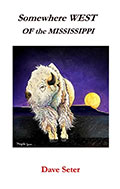 One of the documentary poems in Somewhere West of the Mississippi, “Tribal Fishing Report,” is set at an abandoned copper mine on the Idaho/Nevada border at which I was compelling the corporate successors of the mining companies to conduct a cleanup. The mine was impacting water quality at the Duck Valley Reservation, and whenever I called into the main telephone line for tribal administration, I was greeted with the message: “for the tribal fishing report press one.” The message was clear: without clean water there will not be a healthy fishery. Cleanup of the mine involved unearthing a creek that had been buried by mine tailings. As I relate in the poem:
No trout yet in the creek. Trout need shade but the work done,
legally binding, uprooted the willows. Restoration of shade,
now that the miners have retired to rocking chairs and graves,
may take generations, but hopefully not seven—when—
Fishing report—part three—new willows will penetrate
the rebuilt creek’s clay sandwich. Trout will remember
the sweetness. Shade will overtake the ghost of the bulldozer
Trout will finally find their ancestors at the headwaters.
I hope you can join me for a reading from the new chapbook at Russian River Books and Letters in Guerneville at 7 p.m. on March 22. Details at: https://www.booksletters.com/events/sonoma-county-poet-laureate-david-seter
More details about Somewhere West of the Mississippi can be found on the publisher’s website at: https://mammothpublications.net/dave-seter-west-of-the-mississippi/
And speaking of documentary poetry, there’s still space available in the workshop I ‘m leading at Sebastopol Center for the Arts on Sunday March 30 from 10 am to noon. The workshop is being held in conjunction with the Documentary Film Festival. I’m donating my time to lead the workshop, so all fees collected go toward SebArts programs. Poets of all levels from beginners to experienced poets are encouraged to attend. Details at: https://www.sebarts.org/literary-arts
Dave Seter
Sonoma County Poet Laureate 2024-2026
dssocolaureate@gmail.com
________
February 1, 2025
February has arrived and with it comes Valentine’s Day. Here’s encouraging Sonoma County poets to write gooey love poems if they’re so inclined, or bawdy limericks if they’re so inclined (please keep it clean and don’t demean gender, body type, et cetera). How about if we look at love in a broad context and surprise ourselves?
How about the elegiac poem, modernized? According to The Poetry Foundation, the elegiac poem “is often a melancholy poem that laments its subject’s death but ends in consolation.” The form dates to the 18th century, at which time the rules dictated the form be written in iambic pentameter with a rhyme scheme ABAB. I say: break those rules and write an unabashed love poem to the memory of someone dear to you. I know we already have Dia De Los Muertos, but there’s nothing wrong with expanding our horizons and seasons. I gave myself this assignment and wrote “Letter to Paul,” a poem dedicated to a work colleague in memory of our days together at the New Jersey Department of Environmental Protection. Wanting to reconnect, I sought him out only to find his obituary. One of the stanzas of the poem reads:
When you left this world—I hope, for another—
did you drive the spirit of your cherry red Celica coupe,
the one you spun out—in the NJDEP parking lot—
in front of General Whipple our leader
who frowned upon Hawaiian Shirt Fridays?
Of course, melancholy is present in this poem, but writing the poem brought my friend back to life on the page. Another way of showing love, to our fellow poets, is to write book reviews. Writing reviews helps to focus on not just our own poetry but what we love about poetry in general. Over the past decade I’ve written and published a number of reviews and am working on two new ones. If there’s a book you love, why not write a review? It’s the ultimate exercise in close reading and may give you ideas for new directions to pursue in your own poetry.
Also in the category of close reading, consider translating at least one poem from its native language into another language. The act of translation is for the lover of language. There’s no more intimate act than that of weighing every word and phrase in a poem, deciphering the mystery of another writer. What I love most about translating contemporary Lithuanian poetry is that it reminds me poetry lives across cultures.
In other news, on February 3, please consider joining me at Rivertown Poets in Petaluma at Aqus Café, where I will read with Sonoma County Youth Poet Laureate Lisa Zheng and Sonoma County Youth Poet Ambassador Sabine Wolpert. The reading starts at 6:15 pm and an open mic follows, but please arrive early for food, drink, and conversation.
Lastly, registration is still open for the Poetry Challenge workshops I’ll be leading at Sebastopol Center for the Arts starting in March. There are three workshops in all. Sign up for one or for all three, the choice is yours. Find details at: sebarts.org/literary-arts
Dave Seter
Sonoma County Poet Laureate 2024-2026
dssocolaureate@gmail.com
________
January 1, 2025
In my role encouraging Sonoma County residents to write poetry, I’m making a pitch for us to try our hands at documentary poetry. I plan to teach a workshop on the topic at Sebastopol Center for the Arts in Spring 2025. For those looking to try something different now, why not start writing documentary poetry today? Many of us are already writing about events we witness or world events that touch our lives, and there are ways to add depth to those poems.
There is no officially-recognized definition of documentary poetry. In a lesson plan for Grades 6-8, the Poetry Foundation says documentary poetry is “often written to shed light on an injustice, especially one that many people may not know about.” Suzanne Wazzan, faculty member at Umm Al-Qura University, says documentary poetry “has no unified definition, but one defining line is that it combines artistic talent along with factual material from the real world or the documents of real witnesses.” Poet Mark Nowak cites as early examples of documentary poetry Muriel Rukeyser’s “The Book of the Dead” and Langston Hughes’ “Johannesburg mines.”
As I mentioned, many Sonoma County poets are already writing documentary poetry. One example is Jodi Hottel, who wrote the chapbook Heart Mountain (Blue Light Press, 2012). Hottel’s chapbook explores the involuntary relocation of Japanese Americans during World War II, including the relocation of her mother to Heart Mountain, Wyoming. Another example is Iris Dunkle, who explored the sordid history of the oil boomtown of Pithole, Pennsylvania in a section of her full-length collection Interrupted Geographies (Trio House Press, 2017). In each of these examples, the poet made use of oral accounts or written histories to add depth to their poems.
Because my own poetry tends to ecopoetry, or poetry of the ecology as it intersects our built environment, examples of documentary poetry in my own work are ecologically-themed. In my book Don’t Sing to Me of Electric Fences (Cherry Grove Collections, 2021), the long poem “Climate Change versus Mount Rainier” explores the injustice the human species has done to other species on the mountain. The poem imports text from written accounts of the first recorded ascent of Mount Rainer and of the impact of nuclear weapons testing at Bikini Atoll on the fishing vessel Lucky Dragon Five.
Wondering where to start? Find several useful prompts on writing documentary poetry at the Poetry Foundation website (although the prompts are geared for Grades 6-8, they work for poets of all ages): poetryfoundation.org/articles/157582/documentary-poetics-grades-6-8
Also, here’s a reminder to register for the upcoming “history and poetry” workshop the evening of January 15th at the Museum of Sonoma County: museumsc.org/events/?eid=11800
Here’s wishing you all a healthy, happy, 2025 filled with joy and moments of reflection and self-expression.
Dave Seter
Sonoma County Poet Laureate 2024-2026
dssocolaureate@gmail.com
________
December 1, 2024
They say it takes a village, and in this season where we seek light and joy where we can find it, I’m thankful to be living here in Sonoma County where so many of my fellow villagers are shining examples of caring and compassion.
First of all, many thanks to local broadcast channels that include poetry in their programming. Earlier this Fall, I was a guest on Lin Marie DeVincent’s Poet on the Beat segment on KSVY. More recently, I was a guest on the Resilient Earth Radio podcast on KGUA. KRCB has also offered poetry programming in recent years. Please support these local broadcast channels and check out what they have to offer.
I would also like to announce that topics and dates have been set for the first workshops I’m offering as part of my Poet Laureate Project.
The first workshop is being hosted by The Museum of Sonoma County in Santa Rosa. The topic is: Dusty Artifact or Window Into the Past: Writing Poems About Sonoma County History. This workshop is offered in keeping with the “history” theme of my project. This workshop offers us an opportunity to we explore our personal roots in Sonoma County within the context of the broader history of the county. The workshop takes place on January 15 from 5:30 p.m. to 7:30 p.m. The workshop is free but registration is required. For details and registration information see the following link: https://museumsc.org/events/?eid=11800
The next workshops, a series of three, are being hosted by The Sebastopol Center for the Arts. Sign up for one or for all three, the choice is yours! They are part of a Poetry Challenge series which offers more focused writing themes than a generic workshop does. The first workshop, which takes place March 2 from 1:00 p.m. to 3:00 p.m., is on the topic of Abstraction through Form. The form we will be writing in is called the Questina, which I humorously refer to as the Sestina for the short-attention span poet and reader. The second workshop, which takes place on March 30 from 10:00 a.m.to noon, is on the topic of Documentary Poetry. The third workshop, which takes place on May 4 from 1:00 p.m. to 3:00 p.m., is on the topic of Interweaving Found Text. Registration is required and a sliding scale fee is being charged to support programming at the center for the arts. Find the details here: https://www.sebarts.org/literary-arts
I’m also looking to hold readings and workshops at branches of the Sonoma County Library. Official programming at the library appears to be fully scheduled through next summer but, if there is interest among our writing community, I am considering reserving conference rooms at various branches and holding these events on a more ad hoc basis. Please contact me at dssocolaureate@gmail.com if you would like to see an event at your local branch of the library.
Again, many thanks to local broadcast stations, including KSVY, KGUA, and KRCB, for including poetry programming in their lineups. And many thanks to partner organizations such as The Museum of Sonoma County and The Sebastopol Center for the Arts for hosting poetry events. I’m thankful to be living in Sonoma County and serving as Poet Laureate. Here’s wishing happy holidays to all who celebrate.
Dave Seter
Sonoma County Poet Laureate 2024-2026
dssocolaureate@gmail.com
________
November 1, 2024
Greetings Sonoma County,In October, I had the opportunity to read at the Sun Ridge Elementary School’s Falling Leaves Festival. This festival not only brought back memories of my own childhood but also reinforced how important it is to read to children and include them in our poetry programs. I also helped open the Trashlantis Festival with my poem “Movie Icon Versus Styrofoam Cup”. This festival, which featured a rally of “up-cycled’ bicycles incorporating discarded materials, a fashion pageant for the best outfit made of repurposed material, and other events, reminded me that creativity is key to raising awareness, in a wide audience, about threats to the well-being of Earth’s ecology.
And now, a pitch for Sonoma County poets to consider submitting their poems to the Our California Project of Lee Herrick, California Poet Laureate, and the California Arts Council. For details, go to the following web address: https://capoetlaureate.org/ourcalifornia
There you can find my Sonoma County poem “At Henny Penny Diner” along with many other excellent poems. Here are the key objectives of Lee Herrick’s Our California project:
- To encourage Californians to write poetry, to think about their communities, and to realize that their voice is important.
- To inspire Californians to write poetry that uplifts all people through awareness of social justice or civic engagement.
- To elevate poetry writing as a way to explore one’s creativity and relationship to place.
I would also like to take the opportunity to offer some words of encouragement courtesy of the poet Mary Kinzie. Many thanks to Sonoma County poet Kathleen Winter for introducing me to Mary Kinzie’s A Poet’s Guide to Poetry (University of Chicago Press). In her Introduction, Kinzie writes:
“A poem is neither the clone of a convention nor a mere wildcat product of will, but rather a rescue, within the horizon suggested by a convention, of a new sequence of turnings.”
I like Kinzie’s idea that writing a poem is an act of rescue, in which the poet tries to capture a fleeting thought or feeling using the limited tools of language. I imagine the lines of a poem as rungs of a ladder we climb to rescue our subjects from the clouds of our imaginations.
Plans are in the works for workshops to be hosted by Sebastopol Center for the Arts, The Museum of Sonoma County, and the Sonoma County Library System. Stay tuned. Remember to check out my poet laureate project lesson plans at: https://daveseter.com/poet-laureate-project
Here’s wishing you all a Happy November.
Dave Seter
Sonoma County Poet Laureate 2024-2026
dssocolaureate@gmail.com
________
October 1, 2024
Greetings Sonoma County,I’m pleased to announce the first theme for us to write about together: history. Over the next two years of my term, I plan to guide us through a series of themes seeking to explore what it means to live here. I’ve based the Our Sonoma County project on Our California, a joint project of California Poet Laureate Lee Herick and the California Arts Council. Here are the guiding principles: to encourage Sonoma County residents to write poetry, think about their communities, and realize that their voices are important; to inspire us to write poetry that uplifts all people through awareness of social justice or civic engagement; and, to elevate poetry writing as a way to explore one’s creativity and relationship to place.
Why “history” as the first theme? To truly understand the place where we live, it helps to understand what came before us. That will prepare us to place our lives in context. Spanish American philosopher George Santayana is quoted as saying “Those who do not remember the past are condemned to repeat it.” Let’s keep that in mind as we write, while also flipping this idea to read “Those who remember the successes of the past are more likely to repeat them.”
When we think of history, let’s cast our net wide. The history books include a few stories fished out of the vast ocean of human experience. Sometimes stories are remembered differently by different people. Do you find stories in the history books that match your heritage and personal identity? Are they stories you can relate to? Maybe there really are two sides to every story, as the American idiom says. Or—maybe—there are more than two sides to every story. Maybe some of the stories remain untold, have been forgotten, and are waiting to be discovered.
Where do we begin? When California became the 31st state on September 9, 1850, Sonoma County was incorporated. Our county seat of government was located in the City of Sonoma from 1850 to 1854. Since 1854, it has been located in Santa Rosa. But prior to 1850, at various times, Russia, Spain, and Mexico established communities in what is now Sonoma County. And let’s not forget that native people have lived here the longest, including the Pomo, Coast Miwok and Wappo people, whose villages date back to times before our current era (BCE).
Let’s write together and explore Sonoma County history from many different angles. Then let’s come together in classrooms, in poetry workshops, in writing groups, in readings and open mics, to share what we’ve discovered. Stay tuned to Sonoma County Literary Update to hear about workshops and opportunities to share poems generated through this project. For each theme, I will develop a “lesson plan” of sorts. Those plans will be posted on my website at: https://daveseter.com/poet-laureate-project .
Now, let’s start writing those poems.
Dave Seter
Sonoma County Poet Laureate 2024-2026
dssocolaureate@gmail.com
________
Note: The September 2024 Poet Laureate column by Elizabeth Herron may be found HERE.
________
August 1, 2024
This marks my first blog post as Sonoma County Poet Laureate. First, I would like to say I am grateful for this honor and look forward to encouraging county residents to express, through poetry, what it means to live in Sonoma County. In saying this, I mean all Sonoma County residents—no previous experience necessary. I came to poetry as a civil engineer and hope to serve as a role model for those who are coming to poetry through various career paths.
I would like to give thanks to the outgoing Poet Laureate, Elizabeth Herron, for her service to the poetry community. I follow in the footsteps of all the former Poets Laureate and am grateful for their service as well. Stay tuned to this blog for updates on my forthcoming project Our Sonoma County.
I just returned home from the Napa Valley Writers’ Conference where I took a week long workshop in Poetry in Translation led by Emily Wilson, who recently wrote new translations of Homer’s The Iliad and The Odyssey. The translations I brought to the conference to workshop were of individual poems by contemporary Lithuanian poet Alina Borzenkaitė.
You may ask: why poetry in translation? In addition to a means by which to explore my cultural heritage, I find translation another way to build community. As poets, when we focus on the work of other poets, we open our minds to other ways of seeing the world. When we translate poems from other languages we are working toward building global community.
As poets who read and study poetry, we often speak about the idea of close reading. To me, poetry in translation represents the ultimate in close reading. When I translate a poem, I start word-for-word, looking up each word in hard copy and online dictionaries. Then I move on to research the historical and cultural context of unique words and phrases found in the poem. The goal? To quote the website of Harvard University’s Program in the Classics: The goal of close reading is to notice, describe, and interpret details of the text that are already there, rather than to impose your own point of view. As a general rule of thumb, every claim you make should be directly supported by evidence in the text.
I encourage every poet who has an interest in other cultures to consider translating even one poem as a way to better understand word choice in poetry. In my case, I had never read a word in Lithuanian before that time two years ago when, during the pandemic, I found the need for something to occupy my mind. I also found it comforting to reach out from that place of isolation to find signs of life throughout the world.
If you can, please attend the Poet Laureate inauguration ceremony on Sunday, August 18, starting at 2 PM at the Sebastopol Center for the Arts. Please stop by and say hello and join us in celebrating poetry in Sonoma County. Many thanks to Sebastopol Center for the Arts for sponsoring the laureateship and the inauguration.
In addition to this blog, I will be providing updates to my Poet Laureate project on my website www.daveseter.com and on Instagram: @daveseter_ecopoet. I can be reached by email at dssocolaureate@gmail.com.
Dave Seter
Sonoma County Poet Laureate 2024-2026
dssocolaureate@gmail.com
________
 Sonoma County Literary Update
You must be logged in to post a comment.